Sunday, December 6, 2015

Walt Whitman: "When I heard the Learn'd Astronomer"

I hope you all had an amazing weekend! I realize that I did not spend nearly enough time on our previous Poet. Therefore,  I am going to continue with Walt Whitman.


One of Whitman's well-known poems is tilted "When I heard the Learn'd Astronomer". When reading his work, I have to say that I can relate to the lethargic feeling of this student of astronomy. Though often it is necessary, sometimes sitting in a classroom does little to keep my interest in learning.  I appreciate the stars more when I can personally view them. I love gazing at the sky at night when no lights are around. It is one of the most incredible sights to see. Unfortunately, though I cannot remember all of them, I rather enjoyed studying the star constellations in high-school, and I try to pick out the figures I can recall. 
I think that maybe the author is saying that some things simply cannot be learned inside a classroom. Therefore, it takes more then the scientific knowledge of the universe -or maybe even nature- for us to appreciate, enjoy, and or understand the universe. 

When I heard the Learn'd Astronomer
When I heard the learn’d astronomer,
When the proofs, the figures, were ranged in columns before me,
When I was shown the charts and diagrams, to add, divide, and measure them,
When I sitting heard the astronomer where he lectured with much applause in the lecture-room,
How soon unaccountable I became tired and sick,
Till rising and gliding out I wander’d off by myself,
In the mystical moist night-air, and from time to time,
Look’d up in perfect silence

Monday, November 30, 2015

Walt Whitman: "I Hear America Singing"

Hello to all you happy bloggers out there! I know that it's been a while since I've posted anything new; however, in honor of the Poets, which we are reading in American Literature, I am pleased to inform you that I have decided to continue with Walt Whitman


Resources: 
http://www.poetryfoundation.org/bio/walt-whitman
http://www.poetryfoundation.org/poem/175779

Biography:
Along with Emily Dickinson, Walt Whitman is known as one of America's most significant poets. He was born in Long Island, New York, and he received a limited formal education growing up. In spite of his schooling, Whitman's occupations included reporter, school teacher, printer and editor. Being born in the 19th century, his works reflect the Union loyalties as well as admiration for Abraham Lincoln through the pains of the Civil War.

The poem I read for today is titled " I hear America Singing". I really liked how Whitman mentions various formal jobs with their own individually created song or "music". I think it gives the idea that America unites when it makes music, or in other words when everyone works together and contributes the gifts and talents that they have.  It reveals an impression that no matter who you are (i.e. what occupation you have) you are a part of this nation. Some "sing" melody and some "sing" harmony. Everyone has a place in this national choir. 

I Hear America Singing

BY WALT WHITMAN
I hear America singing, the varied carols I hear,
Those of mechanics, each one singing his as it should be blithe and strong,
The carpenter singing his as he measures his plank or beam,
The mason singing his as he makes ready for work, or leaves off work,
The boatman singing what belongs to him in his boat, the deckhand singing on the steamboat deck,
The shoemaker singing as he sits on his bench, the hatter singing as he stands,
The wood-cutter’s song, the ploughboy’s on his way in the morning, or at noon intermission or at sundown,
The delicious singing of the mother, or of the young wife at work, or of the girl sewing or washing,
Each singing what belongs to him or her and to none else,
The day what belongs to the day—at night the party of young fellows, robust, friendly,
Singing with open mouths their strong melodious songs.


Tuesday, November 17, 2015

Langston Hughes: "The Blues"

I must admit that the poem I read for today made me laugh a little because Hughes's work "The Blues" is very short and blunt in its message. According to the poem, obviously, a person has what is called the "blues" when things are not going well. You might say that this condition is when a person is all out of luck. The author at times can be wordy, but this work definitely does not drag-out his meaning. Actually, I wish that the author would have said more. Regardless of the length, I appreciate that Hughes makes his poems fairly literal and easy to understand.


 Resources:
 http://famouspoetsandpoems.com/poets/langston_hughes/poems/16966
The Blues by Langston Hughes
When the shoe strings break
On both your shoes
And you're in a hurry-
That's the blues.

When you go to buy a candy bar
And you've lost the dime you had-
Slipped through a hole in your pocket somewhere-
That's the blues, too, and bad!

Tuesday, November 10, 2015

Langston Hughes: "The Negro Mother"


Biography:
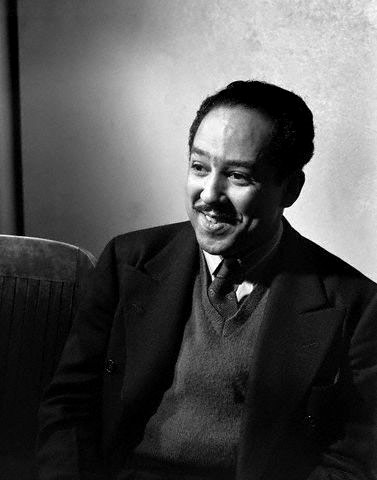
One of the nation's first African American poets is known as James Langston Hughes. Though he was born in Jolplin Missouri, he grew up attending Central High School in Cleveland Ohio where he began writing. His interest in poetry followed him all the way through his college years. Though his father discouraged his literary interests, and even bribed him to pursue an engineering degree at Columbia University, Hughes nevertheless continued to write poetry despite his father's wishes.
True to his African American heritage, the themes of his works encompass the persecution as well as the trials associated with slavery and racism. Both of these topics of which were still being disputed over during the Civil Rights Movement. 


 (1902-1967)

Resources:
http://famouspoetsandpoems.com/poets/langston_hughes/biography
http://famouspoetsandpoems.com/poets/langston_hughes/poems/16951

The poem I read for today is titled "The Negro Mother". In this work, Hughes communicates the hardships and desires of a slave from the perspective of an African American woman. The speaker of the poem is the Negro Mother and she is telling a story to her audience; the children or the future generation of her race. I see the desire in this woman to endure hardship for the sake of her children. Her hope is that some day her children shall be free. Therefore, she wants to be remembered for the work for the sake of others.

The Negro Mother by Langston Hughes
Children, I come back today
To tell you a story of the long dark way
That I had to climb, that I had to know
In order that the race might live and grow.
Look at my face -- dark as the night --
Yet shining like the sun with love's true light.
I am the dark girl who crossed the red sea
Carrying in my body the seed of the free.
I am the woman who worked in the field
Bringing the cotton and the corn to yield.
I am the one who labored as a slave,
Beaten and mistreated for the work that I gave --
Children sold away from me, I'm husband sold, too.
No safety , no love, no respect was I due.

Three hundred years in the deepest South:
But God put a song and a prayer in my mouth .
God put a dream like steel in my soul.
Now, through my children, I'm reaching the goal.

Now, through my children, young and free,
I realized the blessing deed to me.
I couldn't read then. I couldn't write.
I had nothing, back there in the night.
Sometimes, the valley was filled with tears,
But I kept trudging on through the lonely years.
Sometimes, the road was hot with the sun,
But I had to keep on till my work was done:
I had to keep on! No stopping for me --
I was the seed of the coming Free.
I nourished the dream that nothing could smother
Deep in my breast -- the Negro mother.
I had only hope then , but now through you,
Dark ones of today, my dreams must come true:
All you dark children in the world out there,
Remember my sweat, my pain, my despair.
Remember my years, heavy with sorrow --
And make of those years a torch for tomorrow.
Make of my pass a road to the light
Out of the darkness, the ignorance, the night.
Lift high my banner out of the dust.
Stand like free men supporting my trust.
Believe in the right, let none push you back.
Remember the whip and the slaver's track.
Remember how the strong in struggle and strife
Still bar you the way, and deny you life --
But march ever forward, breaking down bars.
Look ever upward at the sun and the stars.
Oh, my dark children, may my dreams and my prayers
Impel you forever up the great stairs --
For I will be with you till no white brother
Dares keep down the children of the Negro Mother.


Sunday, November 8, 2015

Emily Dickinson: "Softened by Time's Consummate plush"


What is time? And why is it useful to us? Is it simply the observable numbers of a clock? Or is a passing of events? 

No doubt, the presence of time is very useful to our hectic lives. Time grows us and or matures us both physically and cognitively. Time aids us with self- discipline and accomplishment. Commonly, time is something we often feel like we do not have enough of, and something that we seldom  use wisely. Emily Dickinson's poem that I read for today is title "Softened by Time's consummate plush". Here the author explains another purpose for time's passing work in our lives. 

Time, something so inanimate, is described by Dickinson as something textual in order to express its effects on our griefs and sorrows. I really appreciate how the author define's time as something perfect and luxurious. I think that she is saying that Time in essence is something that is good for us. It helps our grief's pass by much smoother, and it helps us handle our more current pressing trials. Dickinson mentions that Time bisects or separates bleaker or more present sorrows. Though childhood has its own trials and anguishes, time cushions our "harder" heartaches. Time makes us realize how much easier or simpler it was to handle our childhood trials. Time Strengthens   


SOFTENED by Time’s consummate plush,
  How sleek the woe appears
That threatened childhood’s citadel
  And undermined the years!
  
Bisected now by bleaker griefs,        5
  We envy the despair
That devastated childhood’s realm,
  So easy to repair.

Wednesday, November 4, 2015

Emily Dickinson: "If you were coming in the Fall"

The poem I read for today is titled "If you were coming in the fall". It is one of the works that Dickinson wrote of love. Emily Dickinson is noted as a rather emotionally unstable woman. Therefore, I cannot help but think that her works on love deeply reflected her own inner-personal emotions. May be she was secretly in love with someone? Though she had a close relationship with a few men, her biography states that she and her sister never married. However, when she moved to Philadelphia, she maintained a close relationship to a minister named Charles Wadsworth. 

The speaker of this poem is wondering when she will see her beloved, therefore, she is waiting in anticipation and admits to doing anything to make time go by faster. There is a wanting and a desire of the heart for another in this poem. Time is sometimes a long and hard wall between two people. 


Resources:
http://www.biography.com/people/emily-dickinson-9274190#early-life-and-education

IF you were coming in the fall,
I ’d brush the summer by
With half a smile and half a spurn,
As housewives do a fly.

If I could see you in a year,      5 
 I ’d wind the months in balls,
And put them each in separate drawers,
Until their time befalls.

If only centuries delayed,
I ’d count them on my hand,        10
Subtracting till my fingers dropped
Into Van Diemen’s land.

If certain, when this life was out,
That yours and mine should be,
I ’d toss it yonder like a rind,        15
And taste eternity.

But now, all ignorant of the length
Of time’s uncertain wing,
It goads me, like the goblin bee,
That will not state its sting.        20

Tuesday, November 3, 2015

Emily Dickinson: "Nature, the gentlest mother"

Hello Bloggers,

This week we're going to continue reading the works of Emily Dickinson. Dickinson wrote many poems that speak of nature. The poem I read for today is titled "Nature, the gentlest mother". In this work Dickinson personifies Nature and gives it the tender nurturing abilities of a mother. In comparison to a mother, as mentioned in the poem, nature is patient with children. She is not weak nor mean, but she is mild in her temperament when performing discipline. Nature controls the wild or hasty creatures, and she sweetly and tenderly prepares the earth for sleep.  

I have to admit that this work made me think about the Transcendentalists that we have read such as Emerson and Thoreau. There is something about nature or creation that inspires individuals and leads them to write about its existence. Such with Emerson as with Dickinson, the character of nature is always perceived as good or helpful to the human race. Though recognizably iconic, her writing of Nature as a mother is kind and thoughtful.


NATURE, the gentlest mother,
Impatient of no child,
The feeblest or the waywardest,—
Her admonition mild
  
In forest and the hill        5
By traveller is heard,
Restraining rampant squirrel
Or too impetuous bird.
  
How fair her conversation,
A summer afternoon,—        10
Her household, her assembly;
And when the sun goes down
  
Her voice among the aisles
Incites the timid prayer
Of the minutest cricket,        15
The most unworthy flower.
  
When all the children sleep
She turns as long away
As will suffice to light her lamps;
Then, bending from the sky,        20
  
With infinite affection
And infiniter care,
Her golden finger on her lip,
Wills silence everywhere.

Tuesday, October 27, 2015

Emily Dickinson: "I felt a Funeral, in my Brain"

Good Morning to all of you happy bloggers out there! I hope you enjoyed reading the poems of William Bryant as much as I did. Now, it's time to get ready for the next two weeks ahead because I have chosen the works of Emily Dickinson to be our poems of focus.


(1830-1886)

Resources:
http://famouspoetsandpoems.com/poets/emily_dickinson/biography
http://famouspoetsandpoems.com/poets/emily_dickinson/poems/5399

Biography:
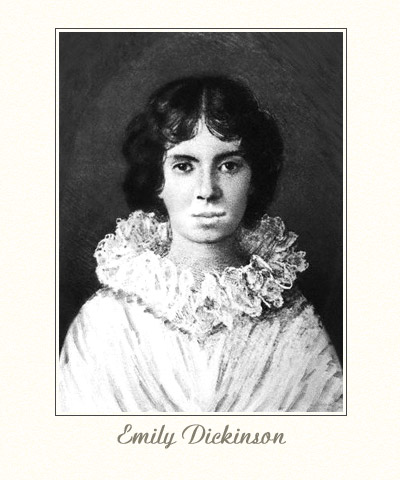
Emily Dickinson was born in Amherst Massachusetts to a devout lawyer and religious housewife. She grew up having a very distant relationship with her parents especially her mother to which she claims that she never had. Though she grew up in a sort of detached family, her works are thought-provoking and relational. After her studies at the Amherst Academy as well as Mount Holyoke Female Seminary, she began to write in 1850. The themes of her poetry range from death to domesticity.

The poem I read for today is titled "I felt a Funeral, in my Brain". Emily Dickinson is quite known for her ability to think outside of the box. Therefore, I am sure that she purposefully chose to describe the happenings of a funeral from the viewpoint of the deceased. However, this does beg the question why? Why does Dickinson refer to herself in this poem? Because she grew up in a dysfunctional family, I wonder if this work is a product of her childhood experiences? It may even suggest that the author was as depressed as her mother. I love the repetition of words used in this poem. It provides an appearance of the mind, and it seems to suggest a subconscious annoyance that occurs through her thoughts.   
I felt a Funeral, in my Brain, by Emily Dickinson
I felt a Funeral, in my Brain,
And Mourners to and fro
Kept treading -- treading -- till it seemed
That Sense was breaking through --

And when they all were seated,
A Service, like a Drum --
Kept beating -- beating -- till I thought
My Mind was going numb --

And then I heard them lift a Box
And creak across my Soul
With those same Boots of Lead, again,
Then Space -- began to toll,

As all the Heavens were a Bell,
And Being, but an Ear,
And I, and Silence, some strange Race
Wrecked, solitary, here --

And then a Plank in Reason, broke,
And I dropped down, and down --
And hit a World, at every plunge,
And Finished knowing -- then --


Saturday, October 24, 2015

William Bryant: "The Strange Lady"

The poem I read for today is titled "The Strange Lady". Something that really stuck out to me in this poem is that Albert was so completely taken with a beautiful stranger that he agreed to go hunting with her and lodge in her house, though he did not know her. Therefore, I think that the reader can learn a good lesson from Bryant's literary work. Sometimes, we can become so distracted or wanting in our desires that we act rashly. To often we end up making poor choices and then later regret our decisions because we act without thinking. Though the reader cannot say for certain that woman had anything to do with Albert's death; however, ultimately, his decision led him to his fatal consequence in the end. 
In addition, I am curious as to the motives of this strange woman. I'm sure that she is dressed the way she is because Bryant wanted the figure to seem mysterious; however, his description of  her disposition seems contrary to her appearance. She is described as happy and kind "her merry eye is full and black, her cheek is brown and bright... And yet she speaks in gentle tones, and in the English tongue". Maybe she is kind because her motivation was to tempt Albert. Therefore, I think that the reader should also learn that appearances can be deceiving.  


The Strange Lady by William Cullen Bryant
The summer morn is bright and fresh, the birds are darting by,
As if they loved to breast the breeze that sweeps the cool dear sky;
Young Albert, in the forest's edge, has heard a rustling sound
An arrow slightly strikes his hand and falls upon the ground.

A lovely woman from the wood comes suddenly in sight;
Her merry eye is full and black, her cheek is brown and bright;
She wears a tunic of the blue, her belt with beads is strung,
And yet she speaks in gentle tones, and in the English tongue.

"It was an idle bolt I sent, against the villain crow;
Fair sir, I fear it harmed thy hand; beshrew my erring bow!"
"Ah! would that bolt had not been spent, then, lady, might I wear
A lasting token on my hand of one so passing fair!"

"Thou art a flatterer like the rest, but wouldst thou take with me
A day of hunting in the wilds, beneath the greenwood tree,
I know where most the pheasants feed, and where the red-deer herd,
And thou shouldst chase the nobler game, and I bring down the bird."

Now Albert in her quiver lays the arrow in its place,
And wonders as he gazes on the beauty of her face:
`Those hunting-grounds are far away, and, lady, 'twere not meet
That night, amid the wilderness, should overtake thy feet."

"Heed not the night, a summer lodge amid the wild is mine,
'Tis shadowed by the tulip-tree, 'tis mantled by the vine;
The wild plum sheds its yellow fruit from fragrant thickets nigh,
And flowery prairies from the door stretch till they meet the sky.

"There in the boughs that hide the roof the mock-bird sits and sings,
And there the hang-bird's brood within its little hammock swings;
A pebbly brook, where rustling winds among the hopples sweep,
Shall lull thee till the morning sun looks in upon thy sleep."

Away, into the forest depths by pleasant paths they go,
He with his rifle on his arm, the lady with her bow,
Where cornels arch their cool dark boughs o'er beds of wintergreen,
And never at his father's door again was Albert seen.

That night upon the woods came down a furious hurricane,
With howl of winds and roar of streams and beating of the rain;
The mighty thunder broke and drowned the noises in its crash;
The old trees seemed to fight like fiends beneath the lightning-flash.

Next day, within a mossy glen, mid mouldering trunks were found
The fragments of a human form, upon the bloody ground;
White bones from which the flesh was torn, and locks of glossy hair;
They laid them in the place of graves, yet wist not whose they were.
And whether famished evening wolves had mangled Albert so,
Or that strange dame so gay and fair were some mysterious foe,
Or whether to that forest lodge, beyond the mountains blue,
He went to dwell with her, the friends who mourned him never knew.

Monday, October 19, 2015

William Bryant: "The Gladness of Nature"

Hello bloggers,

I hope you enjoyed reading the works of Anne Bradstreet! This week I am going to look through the poems of William Cullen Bryant.


(1794-1878)

Resources:
http://famouspoetsandpoems.com/poets/william_cullen_bryant/biography


Biography:
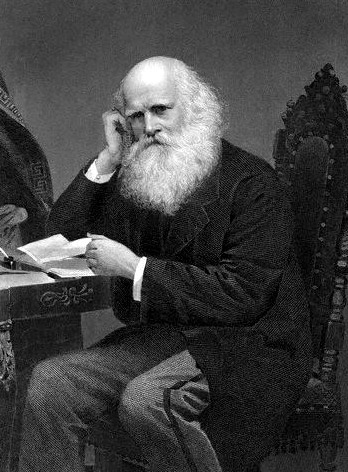
William Cullen Bryant was born in Cummington Hampshire Massachusetts to Peter and Sarah Bryant. At the age of ten he began his literary endeavors by providing writings for the Newspapers. However, at the age of sixteen he enrolled at Williams College where he excelled in Language and Polite Literature. His further studies and practice in law eventually revealed his taste for literature.


The poem I read for today is titled "The Gladness of Nature". In this work, the author gives Nature a human emotion of joyfulness. I think that Bryant is trying to utilize the feelings of nature to provoke certain feelings in a person. It is sort of a new idea to me to think about nature as having a mood. This poem makes me think  about the verse in the book of Ecclesiastes that states "For everything there is a season a time to laugh and a time to cry". By the nature's "mood", it is evident that now is the time for laughter and joyfulness. His question at the beginning of the poem "is it time to be cloudy and sad?" begs a further question for the reader; if the earth is happy then why can't I be? It is obvious then that the author is describing a season of warmth and new-life such as spring or summer. Also, it is thought-provoking that the author alludes to a depressed individual and refers to Nature as his mother. It is almost as if "our mother" is the source of our emotions both figuratively and literally.
The Gladness of Nature by William Cullen Bryant
Is this a time to be cloudy and sad,
When our mother Nature laughs around;
When even the deep blue heavens look glad,
And gladness breathes from the blossoming ground?

There are notes of joy from the hang-bird and wren,
And the gossip of swallows through all the sky;
The ground-squirrel gaily chirps by his den,
And the wilding bee hums merrily by.

The clouds are at play in the azure space,
And their shadows at play on the bright green vale,
And here they stretch to the frolic chase,
And there they roll on the easy gale.

There's a dance of leaves in that aspen bower,
There's a titter of winds in that beechen tree,
There's a smile on the fruit, and a smile on the flower,
And a laugh from the brook that runs to the sea.

And look at the broad-faced sun, how he smiles
On the dewy earth that smiles in his ray,
On the leaping waters and gay young isles;
Ay, look, and he'll smile thy gloom away.

Friday, October 16, 2015

Anne Bradstreet: "The Spirit"

The poem I read by Anne Bradstreet today is titled "Spirit". I must say that I really enjoyed    reading her poem. It is evident that Bradstreet received a solid biblical foundation growing   up as she wrote her works. This particular poem is about her battle with the inner-man.       Being a Christian myself, I can relate to her struggle between the Spirit (that which wants     to please self) and the Holy Spirit (that which wants to please God). She mentions that her  Spirit often has made her a slave. Her spirit forces her to obedience at times. This makes   me think about the same struggles of the apostle Paul. Also, it is interesting that she refers  her Spirit as her twin sister. Her and "her twin" are similar, yet they are completely different min their desires and ambitions. Bradstreet looks forward to heaven when she will no-longer be troubled by her sinful spirit. 


Spirit 
 
Be still, thou unregenerate part, 
Disturb no more my settled heart, 
For I have vow'd (and so will do) 
Thee as a foe still to pursue, 
And combat with thee will and must 
Until I see thee laid in th' dust. 
Sister we are, yea twins we be, 
Yet deadly feud 'twixt thee and me, 
For from one father are we not. 
Thou by old Adam wast begot, 
But my arise is from above, 
Whence my dear father I do love. 
Thou speak'st me fair but hat'st me sore. 
Thy flatt'ring shews I'll trust no more. 
How oft thy slave hast thou me made 
When I believ'd what thou hast said 
And never had more cause of woe 
Than when I did what thou bad'st do. 
I'll stop mine ears at these thy charms 
And count them for my deadly harms. 
Thy sinful pleasures I do hate, 
Thy riches are to me no bait. 
Thine honours do, nor will I love, 
For my ambition lies above. 
My greatest honour it shall be 
When I am victor over thee, 
And Triumph shall, with laurel head, 
When thou my Captive shalt be led. 
How I do live, thou need'st not scoff, 
For I have meat thou know'st not of. 
The hidden Manna I do eat; 
The word of life, it is my meat. 
My thoughts do yield me more content 
Than can thy hours in pleasure spent. 
Nor are they shadows which I catch, 
Nor fancies vain at which I snatch 
But reach at things that are so high, 
Beyond thy dull Capacity. 
Eternal substance I do see 
With which inriched I would be. 
Mine eye doth pierce the heav'ns and see 
What is Invisible to thee. 
My garments are not silk nor gold, 
Nor such like trash which Earth doth hold, 
But Royal Robes I shall have on, 
More glorious than the glist'ring Sun. 
My Crown not Diamonds, Pearls, and gold, 
But such as Angels' heads infold. 
The City where I hope to dwell, 
There's none on Earth can parallel. 
The stately Walls both high and trong 
Are made of precious Jasper stone, 
The Gates of Pearl, both rich and clear, 
And Angels are for Porters there. 
The Streets thereof transparent gold 
Such as no Eye did e're behold. 
A Crystal River there doth run 
Which doth proceed from the Lamb's Throne. 
Of Life, there are the waters sure 
Which shall remain forever pure. 
Nor Sun nor Moon they have no need 
For glory doth from God proceed. 
No Candle there, nor yet Torch light, 
For there shall be no darksome night. 
From sickness and infirmity 
Forevermore they shall be free. 
Nor withering age shall e're come there, 
But beauty shall be bright and clear. 
This City pure is not for thee, 
For things unclean there shall not be. 
If I of Heav'n may have my fill, 
Take thou the world, and all that will." 

Monday, October 12, 2015

Anne Bradstreet: "The Flesh and the Spirit"

Hello to all of you awesome bloggers out there!

Through the course of this semester, I will use this blog spot to post poems of various American poets, and to comment on their works. I will focus on one poet each week to help focus any discussion that may arise. This week I have decided to begin by looking at the works of Anne Bradstreet.


Resources:
http://www.poetryfoundation.org/bio/anne-bradstreet
http://xroads.virginia.edu/~hyper/bradstreet/bradstreet.html#letter

Background:
Though she was originally from England, it is profound that Bradstreet is recognized as the first female New World poet. Through the effects of her Father's homeschooling, she was instilled with a love for reading and writing, and she chose to spend as much time writing as her hectic maternal responsibilities would allow. Her works thoughtfully reflect her family and her religious Puritan background.

The poem I read for today was titled "The Flesh and the Spirit". In this work Bradstreet describes two sisters, called Flesh and Spirit, discussing the temporal versus eternal matters in life. Flesh is the main speaker of the poem, and she is attempting to convince her sister of the realities of the earth as more logic than the mere speculation of heaven. Bradstreet's work can be compared to the words written in the book of Matthew which address the issue of "laying up treasures upon earth" rather than in heaven. In this poem, Flesh is a representation of the voice of the world which often tries to convince Christians that their beliefs are faulty and illogical. I am sure that Anne herself heard this voice in her daily life. No doubt that this poem is the author's recordings of the voice of the flesh in her own mind.

The Flesh and the Spirit
In secret place where once I stood 
Close by the Banks of Lacrim flood, 
I heard two sisters reason on 
Things that are past and things to come. 
One Flesh was call'd, who had her eye 
On worldly wealth and vanity; 
The other Spirit, who did rear 
Her thoughts unto a higher sphere. 
"Sister," quoth Flesh, "what liv'st thou on 
Nothing but Meditation? 
Doth Contemplation feed thee so 
Regardlessly to let earth go? 
Can Speculation satisfy 
Notion without Reality? 
Dost dream of things beyond the Moon 
And dost thou hope to dwell there soon? 
Hast treasures there laid up in store 
That all in th' world thou count'st but poor? 
Art fancy-sick or turn'd a Sot 
To catch at shadows which are not? 
Come, come. I'll show unto thy sense, 
Industry hath its recompence. 
What canst desire, but thou maist see 
True substance in variety? 
Dost honour like? Acquire the same, 
As some to their immortal fame; 
And trophies to thy name erect 
Which wearing time shall ne'er deject. 
For riches dost thou long full sore? 
Behold enough of precious store. 
Earth hath more silver, pearls, and gold 
Than eyes can see or hands can hold. 
Affects thou pleasure? Take thy fill. 
Earth hath enough of what you will. 
Then let not go what thou maist find 
For things unknown only in mind."