Sunday, December 6, 2015

Walt Whitman: "When I heard the Learn'd Astronomer"

I hope you all had an amazing weekend! I realize that I did not spend nearly enough time on our previous Poet. Therefore,  I am going to continue with Walt Whitman.


One of Whitman's well-known poems is tilted "When I heard the Learn'd Astronomer". When reading his work, I have to say that I can relate to the lethargic feeling of this student of astronomy. Though often it is necessary, sometimes sitting in a classroom does little to keep my interest in learning.  I appreciate the stars more when I can personally view them. I love gazing at the sky at night when no lights are around. It is one of the most incredible sights to see. Unfortunately, though I cannot remember all of them, I rather enjoyed studying the star constellations in high-school, and I try to pick out the figures I can recall. 
I think that maybe the author is saying that some things simply cannot be learned inside a classroom. Therefore, it takes more then the scientific knowledge of the universe -or maybe even nature- for us to appreciate, enjoy, and or understand the universe. 

When I heard the Learn'd Astronomer
When I heard the learn’d astronomer,
When the proofs, the figures, were ranged in columns before me,
When I was shown the charts and diagrams, to add, divide, and measure them,
When I sitting heard the astronomer where he lectured with much applause in the lecture-room,
How soon unaccountable I became tired and sick,
Till rising and gliding out I wander’d off by myself,
In the mystical moist night-air, and from time to time,
Look’d up in perfect silence

Monday, November 30, 2015

Walt Whitman: "I Hear America Singing"

Hello to all you happy bloggers out there! I know that it's been a while since I've posted anything new; however, in honor of the Poets, which we are reading in American Literature, I am pleased to inform you that I have decided to continue with Walt Whitman


Resources: 
http://www.poetryfoundation.org/bio/walt-whitman
http://www.poetryfoundation.org/poem/175779

Biography:
Along with Emily Dickinson, Walt Whitman is known as one of America's most significant poets. He was born in Long Island, New York, and he received a limited formal education growing up. In spite of his schooling, Whitman's occupations included reporter, school teacher, printer and editor. Being born in the 19th century, his works reflect the Union loyalties as well as admiration for Abraham Lincoln through the pains of the Civil War.

The poem I read for today is titled " I hear America Singing". I really liked how Whitman mentions various formal jobs with their own individually created song or "music". I think it gives the idea that America unites when it makes music, or in other words when everyone works together and contributes the gifts and talents that they have.  It reveals an impression that no matter who you are (i.e. what occupation you have) you are a part of this nation. Some "sing" melody and some "sing" harmony. Everyone has a place in this national choir. 

I Hear America Singing

BY WALT WHITMAN
I hear America singing, the varied carols I hear,
Those of mechanics, each one singing his as it should be blithe and strong,
The carpenter singing his as he measures his plank or beam,
The mason singing his as he makes ready for work, or leaves off work,
The boatman singing what belongs to him in his boat, the deckhand singing on the steamboat deck,
The shoemaker singing as he sits on his bench, the hatter singing as he stands,
The wood-cutter’s song, the ploughboy’s on his way in the morning, or at noon intermission or at sundown,
The delicious singing of the mother, or of the young wife at work, or of the girl sewing or washing,
Each singing what belongs to him or her and to none else,
The day what belongs to the day—at night the party of young fellows, robust, friendly,
Singing with open mouths their strong melodious songs.


Tuesday, November 17, 2015

Langston Hughes: "The Blues"

I must admit that the poem I read for today made me laugh a little because Hughes's work "The Blues" is very short and blunt in its message. According to the poem, obviously, a person has what is called the "blues" when things are not going well. You might say that this condition is when a person is all out of luck. The author at times can be wordy, but this work definitely does not drag-out his meaning. Actually, I wish that the author would have said more. Regardless of the length, I appreciate that Hughes makes his poems fairly literal and easy to understand.


 Resources:
 http://famouspoetsandpoems.com/poets/langston_hughes/poems/16966
The Blues by Langston Hughes
When the shoe strings break
On both your shoes
And you're in a hurry-
That's the blues.

When you go to buy a candy bar
And you've lost the dime you had-
Slipped through a hole in your pocket somewhere-
That's the blues, too, and bad!

Tuesday, November 10, 2015

Langston Hughes: "The Negro Mother"


Biography:
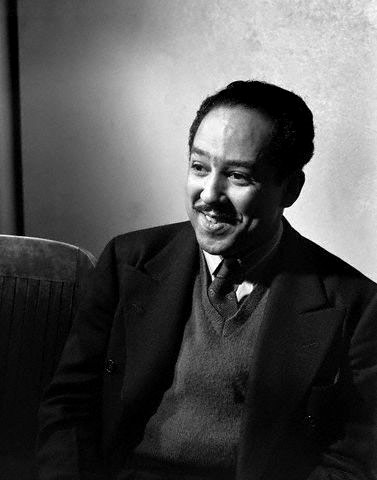
One of the nation's first African American poets is known as James Langston Hughes. Though he was born in Jolplin Missouri, he grew up attending Central High School in Cleveland Ohio where he began writing. His interest in poetry followed him all the way through his college years. Though his father discouraged his literary interests, and even bribed him to pursue an engineering degree at Columbia University, Hughes nevertheless continued to write poetry despite his father's wishes.
True to his African American heritage, the themes of his works encompass the persecution as well as the trials associated with slavery and racism. Both of these topics of which were still being disputed over during the Civil Rights Movement. 


 (1902-1967)

Resources:
http://famouspoetsandpoems.com/poets/langston_hughes/biography
http://famouspoetsandpoems.com/poets/langston_hughes/poems/16951

The poem I read for today is titled "The Negro Mother". In this work, Hughes communicates the hardships and desires of a slave from the perspective of an African American woman. The speaker of the poem is the Negro Mother and she is telling a story to her audience; the children or the future generation of her race. I see the desire in this woman to endure hardship for the sake of her children. Her hope is that some day her children shall be free. Therefore, she wants to be remembered for the work for the sake of others.

The Negro Mother by Langston Hughes
Children, I come back today
To tell you a story of the long dark way
That I had to climb, that I had to know
In order that the race might live and grow.
Look at my face -- dark as the night --
Yet shining like the sun with love's true light.
I am the dark girl who crossed the red sea
Carrying in my body the seed of the free.
I am the woman who worked in the field
Bringing the cotton and the corn to yield.
I am the one who labored as a slave,
Beaten and mistreated for the work that I gave --
Children sold away from me, I'm husband sold, too.
No safety , no love, no respect was I due.

Three hundred years in the deepest South:
But God put a song and a prayer in my mouth .
God put a dream like steel in my soul.
Now, through my children, I'm reaching the goal.

Now, through my children, young and free,
I realized the blessing deed to me.
I couldn't read then. I couldn't write.
I had nothing, back there in the night.
Sometimes, the valley was filled with tears,
But I kept trudging on through the lonely years.
Sometimes, the road was hot with the sun,
But I had to keep on till my work was done:
I had to keep on! No stopping for me --
I was the seed of the coming Free.
I nourished the dream that nothing could smother
Deep in my breast -- the Negro mother.
I had only hope then , but now through you,
Dark ones of today, my dreams must come true:
All you dark children in the world out there,
Remember my sweat, my pain, my despair.
Remember my years, heavy with sorrow --
And make of those years a torch for tomorrow.
Make of my pass a road to the light
Out of the darkness, the ignorance, the night.
Lift high my banner out of the dust.
Stand like free men supporting my trust.
Believe in the right, let none push you back.
Remember the whip and the slaver's track.
Remember how the strong in struggle and strife
Still bar you the way, and deny you life --
But march ever forward, breaking down bars.
Look ever upward at the sun and the stars.
Oh, my dark children, may my dreams and my prayers
Impel you forever up the great stairs --
For I will be with you till no white brother
Dares keep down the children of the Negro Mother.


Sunday, November 8, 2015

Emily Dickinson: "Softened by Time's Consummate plush"


What is time? And why is it useful to us? Is it simply the observable numbers of a clock? Or is a passing of events? 

No doubt, the presence of time is very useful to our hectic lives. Time grows us and or matures us both physically and cognitively. Time aids us with self- discipline and accomplishment. Commonly, time is something we often feel like we do not have enough of, and something that we seldom  use wisely. Emily Dickinson's poem that I read for today is title "Softened by Time's consummate plush". Here the author explains another purpose for time's passing work in our lives. 

Time, something so inanimate, is described by Dickinson as something textual in order to express its effects on our griefs and sorrows. I really appreciate how the author define's time as something perfect and luxurious. I think that she is saying that Time in essence is something that is good for us. It helps our grief's pass by much smoother, and it helps us handle our more current pressing trials. Dickinson mentions that Time bisects or separates bleaker or more present sorrows. Though childhood has its own trials and anguishes, time cushions our "harder" heartaches. Time makes us realize how much easier or simpler it was to handle our childhood trials. Time Strengthens   


SOFTENED by Time’s consummate plush,
  How sleek the woe appears
That threatened childhood’s citadel
  And undermined the years!
  
Bisected now by bleaker griefs,        5
  We envy the despair
That devastated childhood’s realm,
  So easy to repair.

Wednesday, November 4, 2015

Emily Dickinson: "If you were coming in the Fall"

The poem I read for today is titled "If you were coming in the fall". It is one of the works that Dickinson wrote of love. Emily Dickinson is noted as a rather emotionally unstable woman. Therefore, I cannot help but think that her works on love deeply reflected her own inner-personal emotions. May be she was secretly in love with someone? Though she had a close relationship with a few men, her biography states that she and her sister never married. However, when she moved to Philadelphia, she maintained a close relationship to a minister named Charles Wadsworth. 

The speaker of this poem is wondering when she will see her beloved, therefore, she is waiting in anticipation and admits to doing anything to make time go by faster. There is a wanting and a desire of the heart for another in this poem. Time is sometimes a long and hard wall between two people. 


Resources:
http://www.biography.com/people/emily-dickinson-9274190#early-life-and-education

IF you were coming in the fall,
I ’d brush the summer by
With half a smile and half a spurn,
As housewives do a fly.

If I could see you in a year,      5 
 I ’d wind the months in balls,
And put them each in separate drawers,
Until their time befalls.

If only centuries delayed,
I ’d count them on my hand,        10
Subtracting till my fingers dropped
Into Van Diemen’s land.

If certain, when this life was out,
That yours and mine should be,
I ’d toss it yonder like a rind,        15
And taste eternity.

But now, all ignorant of the length
Of time’s uncertain wing,
It goads me, like the goblin bee,
That will not state its sting.        20

Tuesday, November 3, 2015

Emily Dickinson: "Nature, the gentlest mother"

Hello Bloggers,

This week we're going to continue reading the works of Emily Dickinson. Dickinson wrote many poems that speak of nature. The poem I read for today is titled "Nature, the gentlest mother". In this work Dickinson personifies Nature and gives it the tender nurturing abilities of a mother. In comparison to a mother, as mentioned in the poem, nature is patient with children. She is not weak nor mean, but she is mild in her temperament when performing discipline. Nature controls the wild or hasty creatures, and she sweetly and tenderly prepares the earth for sleep.  

I have to admit that this work made me think about the Transcendentalists that we have read such as Emerson and Thoreau. There is something about nature or creation that inspires individuals and leads them to write about its existence. Such with Emerson as with Dickinson, the character of nature is always perceived as good or helpful to the human race. Though recognizably iconic, her writing of Nature as a mother is kind and thoughtful.


NATURE, the gentlest mother,
Impatient of no child,
The feeblest or the waywardest,—
Her admonition mild
  
In forest and the hill        5
By traveller is heard,
Restraining rampant squirrel
Or too impetuous bird.
  
How fair her conversation,
A summer afternoon,—        10
Her household, her assembly;
And when the sun goes down
  
Her voice among the aisles
Incites the timid prayer
Of the minutest cricket,        15
The most unworthy flower.
  
When all the children sleep
She turns as long away
As will suffice to light her lamps;
Then, bending from the sky,        20
  
With infinite affection
And infiniter care,
Her golden finger on her lip,
Wills silence everywhere.